Thank you for your patience while we retrieve your images.
Visitors 27


« Previous Next »
177 of 1276 photos

120706_TODD_0463

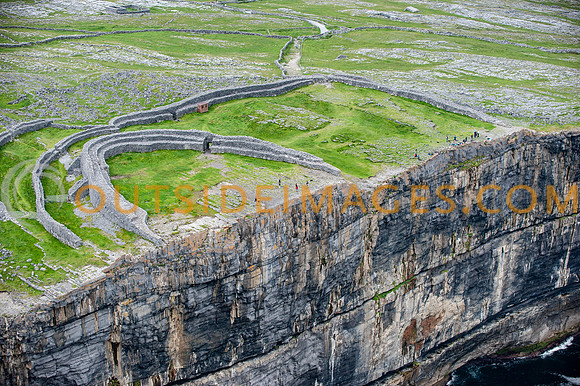
Stock images of Dún Aonghasa, Kilmurvy, Co. Galway, Ireland.
Perched on a cliff overlooking the Atlantic ocean, Dún Aonghasa is the largest of the prehistoric stone forts of the Aran Islands. The fort consists of three massive dry-stone walls and a chevaux-de-frise, a dense band of jagged, upright stones, surrounding the fort from cliff to cliff, designed to impede attackers. Originally constructed c.1100BC, it was re-fortified around 700-800 AD. Excavations revealed significant evidence of prehistoric metalworking, as well as several houses and burials.
It is not known exactly when Dún Aonghasa was built, though it is now thought that most of the structures date from the Bronze Age and Iron Age. T. F. O'Rahilly surmised in what is known O'Rahilly's historical model that it was built in the 2nd century BC by the Builg following the Laginian conquest of Connacht.Excavations at the site indicate that the first construction goes back to 1100 BC, when the first enclosure was erected by piling rubble against large upright stones. Around 500 BC, the triple wall defences were probably built along the western side of the fort
Stock images of coastlines in Ireland.
©Paul Todd/OUTSIDEIMAGES.COM
OUTSIDE IMAGES PHOTO AGENCY

Categories & Keywords
Category:
Subcategory:
Subcategory Detail:
Keywords:Stock images for sale of Galway Ireland, Dramatic Landscape, Dún Aonghasa, ship wreck, stock marine images, stock nautical images, stock images of coastlines, Aran Island, stone walling, stone walls, Atlantic, Galway, Ireland, Sea, clouds, coastline, green, ocean, weather " images of Cliffs of Moher" "Aerial View"

120706_TODD_0463

120706_TODD_0463

Stock images of Dún Aonghasa, Kilmurvy, Co. Galway, Ireland.
Perched on a cliff overlooking the Atlantic ocean, Dún Aonghasa is the largest of the prehistoric stone forts of the Aran Islands. The fort consists of three massive dry-stone walls and a chevaux-de-frise, a dense band of jagged, upright stones, surrounding the fort from cliff to cliff, designed to impede attackers. Originally constructed c.1100BC, it was re-fortified around 700-800 AD. Excavations revealed significant evidence of prehistoric metalworking, as well as several houses and burials.
It is not known exactly when Dún Aonghasa was built, though it is now thought that most of the structures date from the Bronze Age and Iron Age. T. F. O'Rahilly surmised in what is known O'Rahilly's historical model that it was built in the 2nd century BC by the Builg following the Laginian conquest of Connacht.Excavations at the site indicate that the first construction goes back to 1100 BC, when the first enclosure was erected by piling rubble against large upright stones. Around 500 BC, the triple wall defences were probably built along the western side of the fort
Stock images of coastlines in Ireland.
©Paul Todd/OUTSIDEIMAGES.COM
OUTSIDE IMAGES PHOTO AGENCY