Thank you for your patience while we retrieve your images.
Visitors 0


« Previous Next »
34 of 1529 photos

131206_TODD_00710

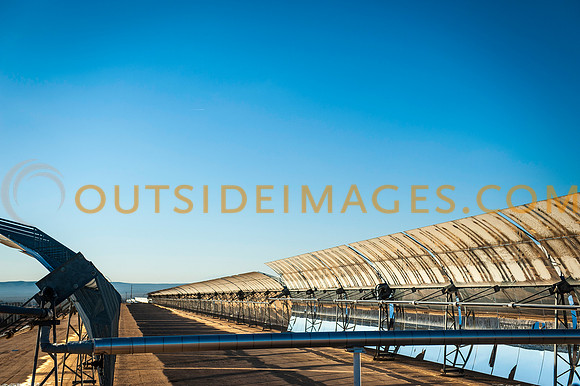
Stock images of Parabolic reflector for the SEGS solar power plant.
Solar power in California has been growing rapidly because of high insolation, community support, declining solar costs, and a Renewable Portfolio Standard which requires that 25% of California's electricity come from renewable resources by 2016, and 33% by 2020.[1] Much of this is expected to come from solar power. As of the end of 2013, California had 490 MW of concentrated solar power and 5,183 MW of photovoltaics capacity in operation.The American Solar Energy Industries Association reports that a further 19,200 MW of utility-scale solar projects are under construction or development in the state as of August 2014.
The largest solar power installation in the world was the 354 MW solar thermal SEGS plant, completed in 1991. The Ivanpah Solar Electric Generating System (392 MW), located 40 miles (60 km) southwest of Las Vegas, recently overtook it 6 miles (9.7 km) east of Boron, across the county line in San Bernardino County, is the world's largest solar power production facility.[13] The Kramer Junction Company (KJC) is the Managing General Partner of the five 30-Megawatts Solar Energy Generating Systems (SEGS) facilities located in the Mojave Desert at Kramer Junction, California. Together with its wholly owned subsidiary, KJC Operating Company, KJC operates and manages these facilities (SEGS III-VII).[14] These units generate enough electricity to provide the electrical needs of 30,000 to 40,000 homes without the use of fossil fuels.
Boron is a hinterland community on the western edge of the Mojave Desert. Within a half day's drive one can view the highest and lowest points in the contiguous 48 states of the United States (Mount Whitney and Death Valley), the world's oldest tree (the Bristlecone Pine), and the cities of both Los Angeles and Las Vegas.
Boron is home to the U.S. Borax Boron Mine, California's largest open-pit mine, which is also the largest borax mine in the world. 35°2′34.44″N 117°40′45.41″W
©Paul Todd/OUTSIDEIMAGES.COM
OUTSIDE IMAGES PHOTO AGENCY

Categories & Keywords
Category:
Subcategory:
Subcategory Detail:
Keywords:thermal system, Kern County, Stock images of solar power plant, death valley, Owens Valley, lone Pine, California.California, death valley national park, desert southwest, national park, power plant, Death Valley, Desert, Environmental, HORIZONTAL, Industrial, Mount Whitney, Mountains, Travel, USA, White Mountains, alternative, america, arid, array, badlands, beautiful, beauty, blue, business, cell, change, clean, climate, clouds, collector, conductors, dawn, death, desolate, desolation, dry, dune, eco, eco tourism, ecological, ecology, electric, electrical, electricity, environment, equipment, erosion, erosional, field, fuel, future, futuristic, generation, generator, geologic, geological, geology, global, global warming, grass, green, hot, house, industry, innovation, installation, landscape, landscapes, lenergy, light, modern, national, nature, outdoor, outdoors, panel, park, pattern, photovoltaic, plant, power, protection, renewable, roof, rugged, sand, scenery, scenic, science, sky, solar, southwest, station, summer, sun, sunlight, sunny, sunrise, sunset, supply, technology, valley, vertical, warming, wilderness, winter

131206_TODD_00710

131206_TODD_00710

Stock images of Parabolic reflector for the SEGS solar power plant.
Solar power in California has been growing rapidly because of high insolation, community support, declining solar costs, and a Renewable Portfolio Standard which requires that 25% of California's electricity come from renewable resources by 2016, and 33% by 2020.[1] Much of this is expected to come from solar power. As of the end of 2013, California had 490 MW of concentrated solar power and 5,183 MW of photovoltaics capacity in operation.The American Solar Energy Industries Association reports that a further 19,200 MW of utility-scale solar projects are under construction or development in the state as of August 2014.
The largest solar power installation in the world was the 354 MW solar thermal SEGS plant, completed in 1991. The Ivanpah Solar Electric Generating System (392 MW), located 40 miles (60 km) southwest of Las Vegas, recently overtook it 6 miles (9.7 km) east of Boron, across the county line in San Bernardino County, is the world's largest solar power production facility.[13] The Kramer Junction Company (KJC) is the Managing General Partner of the five 30-Megawatts Solar Energy Generating Systems (SEGS) facilities located in the Mojave Desert at Kramer Junction, California. Together with its wholly owned subsidiary, KJC Operating Company, KJC operates and manages these facilities (SEGS III-VII).[14] These units generate enough electricity to provide the electrical needs of 30,000 to 40,000 homes without the use of fossil fuels.
Boron is a hinterland community on the western edge of the Mojave Desert. Within a half day's drive one can view the highest and lowest points in the contiguous 48 states of the United States (Mount Whitney and Death Valley), the world's oldest tree (the Bristlecone Pine), and the cities of both Los Angeles and Las Vegas.
Boron is home to the U.S. Borax Boron Mine, California's largest open-pit mine, which is also the largest borax mine in the world. 35°2′34.44″N 117°40′45.41″W
©Paul Todd/OUTSIDEIMAGES.COM
OUTSIDE IMAGES PHOTO AGENCY